

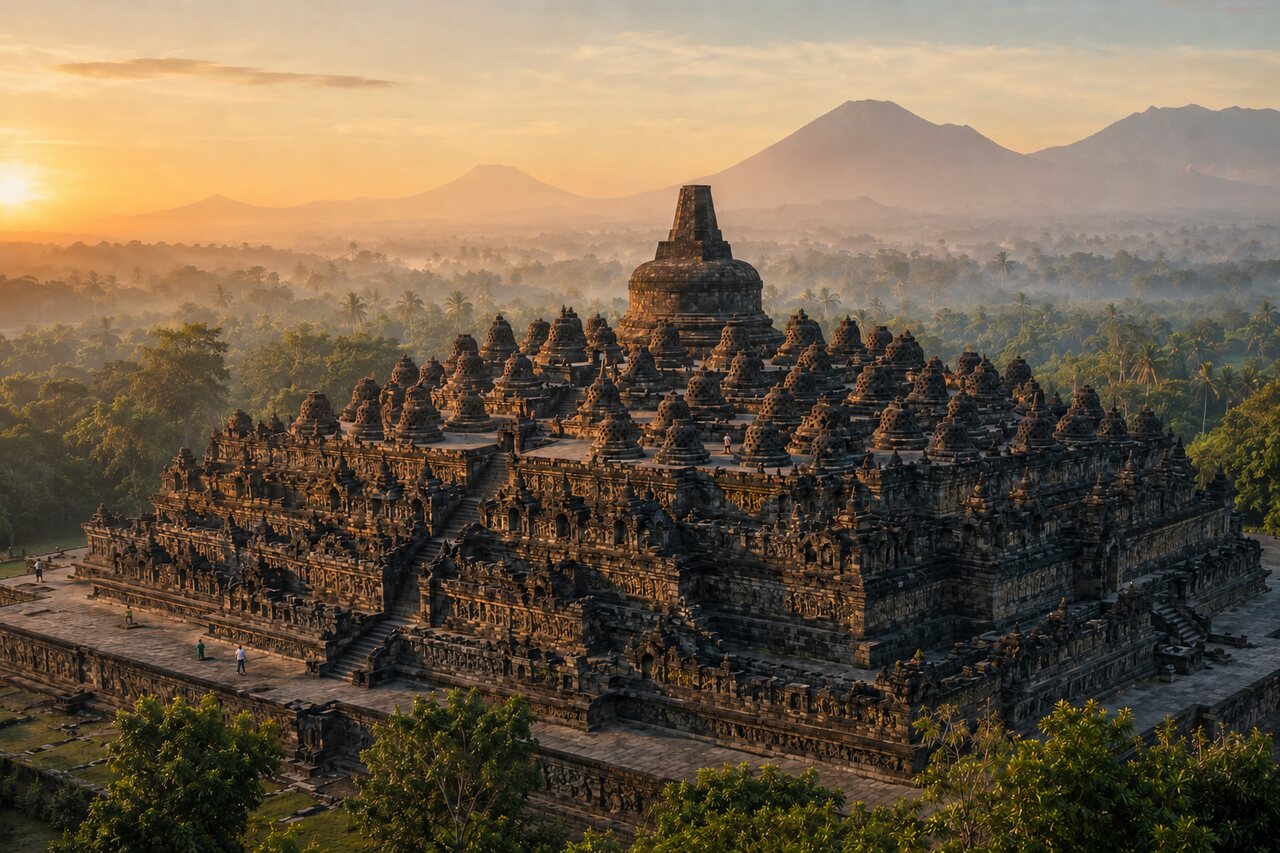
A Borobudur Temple History Guide helps travelers understand the remarkable story behind one of Indonesia’s most important historical monuments. Borobudur represents centuries of Buddhist heritage, ancient Javanese civilization, and architectural achievement that continues to inspire visitors today.
Many travelers visit Borobudur because of its impressive appearance and peaceful atmosphere. However, the history behind the temple reveals a much deeper story about religion, culture, and human creativity.
For travelers aged 25 and above, learning about Borobudur’s history creates a more meaningful experience. Understanding its origins allows visitors to appreciate the monument as a symbol of ancient knowledge and cultural achievement.
The Beginning of Borobudur Temple History
The Borobudur Temple History Guide begins during the Sailendra Dynasty around the 8th and 9th centuries.
Ancient Javanese builders constructed Borobudur in Central Java as a Mahayana Buddhist monument. The temple was created as a place for spiritual learning, meditation, and religious activities.
The construction reflected the growth of Buddhism in ancient Java. During this period, the Sailendra Kingdom developed significant cultural and architectural achievements.
Furthermore, Borobudur demonstrated the connection between religious beliefs and advanced construction methods.
Travelers can discover more about Borobudur’s history, architecture, and cultural significance through this complete guide to Borobudur Temple facts, history, architecture, and culture.
The Purpose Behind Borobudur Construction
Borobudur was not built only as a historical monument.
The temple was designed as a symbolic journey toward enlightenment. Its structure represents Buddhist teachings through three main sections: Kamadhatu, Rupadhatu, and Arupadhatu.
Lower section represents human desires and worldly experiences.
The middle section represents awareness and the process of overcoming attachments.
The upper section represents spiritual freedom and enlightenment.
Therefore, every part of Borobudur carries philosophical meaning.
Borobudur During Ancient Javanese Civilization
Borobudur played an important role in ancient Javanese society.
The temple became a center for Buddhist activities and cultural development. Its relief panels also recorded information about ancient life.
Visitors can observe scenes showing traditional buildings, transportation, clothing, and social activities.
These carvings provide valuable evidence about how people lived during the Sailendra period.
Additionally, Borobudur reflects the artistic abilities of ancient craftsmen who created detailed stone artwork without modern technology.
The Rediscovery of Borobudur
Over centuries, Borobudur experienced changes caused by natural conditions and historical events.
The temple was gradually covered by volcanic ash and vegetation, causing it to remain hidden for hundreds of years.
In the early 19th century, Borobudur was rediscovered and received attention from historians and researchers.
Since then, several restoration programs have protected the monument from further damage.
Today, visitors can explore Borobudur because of these preservation efforts.
Borobudur as a Cultural Legacy
Borobudur continues to represent the cultural identity of Indonesia.
The monument connects ancient history, Buddhist philosophy, architecture, and local traditions.
Its global recognition shows the importance of preserving historical sites for future generations.
Moreover, Borobudur provides educational value for travelers who want to understand Indonesia’s past.
Exploring Borobudur With Deeper Understanding
A guided visit can make a Borobudur journey more meaningful.
Local guides explain the stories behind the reliefs, architectural elements, and historical events connected with the temple.
This knowledge helps travelers discover details that may be missed during independent exploration.
For travelers who want a comfortable cultural journey, explore professional Yogyakarta tour services with local guides and customized travel experiences.
Discover the Legacy of Ancient Java
A Borobudur Temple History Guide reveals how an ancient monument continues to preserve stories from the past.
Borobudur is not only a destination but also a journey through history, culture, and human creativity.
Plan your Yogyakarta adventure and discover the incredible legacy of ancient Java at Borobudur Temple.
