

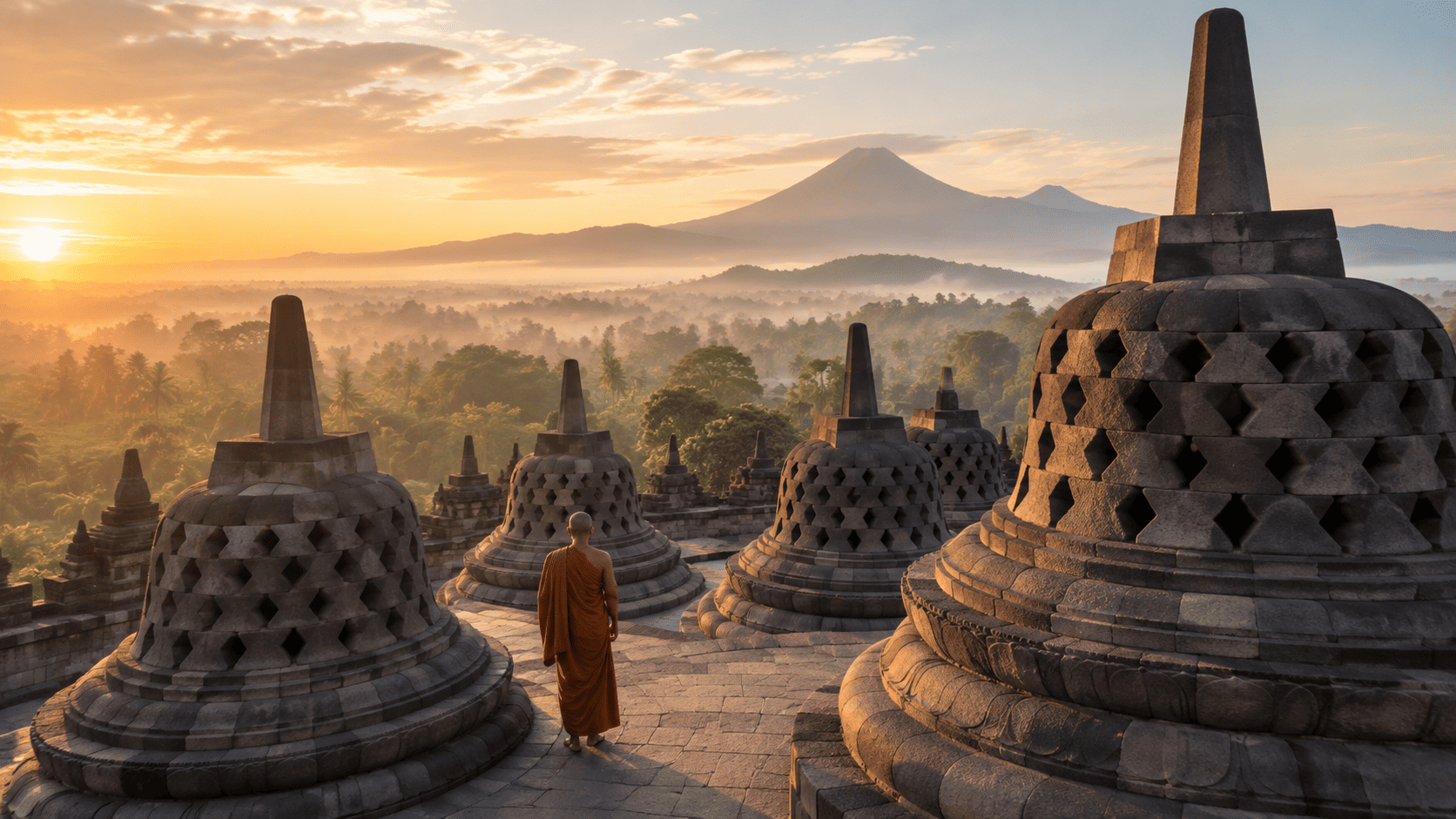
The Borobudur Temple Stupa Meaning connects directly with the monument’s Buddhist design and spiritual message. Borobudur uses stupas not only as architectural features but also as symbols within a journey toward enlightenment. Their position, form, and arrangement become more meaningful as visitors move from the lower galleries to the open circular terraces.
What Is a Stupa at Borobudur?
A stupa is a Buddhist monument that carries religious and symbolic importance. At Borobudur, stupas dominate the upper levels and create the temple’s most recognizable silhouette.
UNESCO records 72 openwork stupas around the three circular platforms. Each stupa contains a Buddha statue. A much larger stupa stands at the center and crowns the entire monument.
The arrangement creates a clear shift from the detailed lower galleries to the simpler upper terraces. Visitors leave behind walls filled with reliefs and enter a more open space with repeating geometric forms.
Why Are There 72 Stupas?
The 72 smaller stupas surround the central stupa in orderly rows. Their repetition creates balance and directs attention toward the center of Borobudur.
Each openwork stupa contains a Buddha image that visitors can see through the stone lattice. This design combines physical form with a sense of concealment and stillness.
The number and placement also strengthen the monument’s overall symmetry. Rather than acting as separate decorations, the stupas form part of one carefully organized architectural system.
For a broader explanation of the monument, read our guide to facts about Borobudur Temple. It explores Borobudur’s history, architecture, Buddhist meaning, and other important details.
Stupas and the Arupadhatu Realm
The upper circular terraces represent Arupadhatu in Buddhist cosmology. UNESCO describes Arupadhatu as the sphere of formlessness, where name and form no longer bind the individual.
This idea explains why the architecture becomes simpler near the top. The lower sections contain dense reliefs, walls, and narrative detail. The upper levels replace that complexity with open space, circular movement, and stupas.
As visitors climb, the visual environment gradually becomes calmer. The change supports the symbolic journey from worldly attachment toward spiritual liberation.
What Does the Central Stupa Represent?
The large central stupa forms the highest architectural point of Borobudur. It sits above the three circular terraces and gives the monument a strong visual center.
Within the wider Buddhist design, the central stupa completes the upward journey through Kamadhatu, Rupadhatu, and Arupadhatu. It represents the final stage of the monument’s movement toward the idea of Nirvana.
Its simple form also contrasts with the richly decorated galleries below. That contrast helps express the transition from material complexity toward greater spiritual simplicity.
How to Appreciate the Stupas During a Visit
Do not treat the upper terraces only as a photo location. Walk slowly and notice how the openwork stupas repeat around each level. Look at their relationship with the central stupa and surrounding landscape.
A local guide can explain the connection between the stupas, Buddhist cosmology, and Borobudur’s overall design. Travelers who want deeper context can explore a private Borobudur tour from Yogyakarta.
Respect the monument during your visit. Avoid touching restricted parts or climbing onto stone structures. Following site rules helps protect Borobudur for future visitors.
Conclusion
The Borobudur Temple Stupa Meaning comes from the relationship between architecture and Buddhist cosmology. The 72 openwork stupas, Buddha images, circular terraces, and central stupa all support the symbolic journey toward enlightenment.
When you understand this design, the upper terraces become more than an iconic view. They reveal how Borobudur turns stone, space, and movement into a powerful spiritual message.
